

The CEE advertising market: CANnual Report 2021
On the road to recovery
Advertising expenditure had been growing strongly across Central and Eastern Europe for years. In 2020, COVID-19 brought an 8% decline, equivalent to around €1.2 billion. Budgets fell across the media market, while online channels benefited from the shift towards digital. Changing consumer behaviour also reshaped how businesses communicate and build relationships with their audiences.
weCAN, the network of independent advertising and media agencies in Central and Eastern Europe, has published its seventh CANnual Report. It examines 15 CEE markets, focusing on the impact of COVID-19 on the region. Alongside market data, weCAN experts compare the pandemic with earlier crises, including the 2008 financial crisis, the annexation of Crimea and the Agrokor crisis. A guest contribution by Dr Mária Törőcsik, an economist and professor at the University of Pécs, traces changes in CEE consumer attitudes since 1990.
The Polish chapter was written by Weronika Szwarc-Bronikowska, Vice President of Media People and a lecturer at SWPS University, and Paweł Heinze, Creative Director at Walk.
A region shaken by the virus
The CANnual Report 2021 shows that the pandemic interrupted five years of steady growth. Regional advertising expenditure fell by 8% in 2020, a decline of €1.2 billion compared with the previous year.
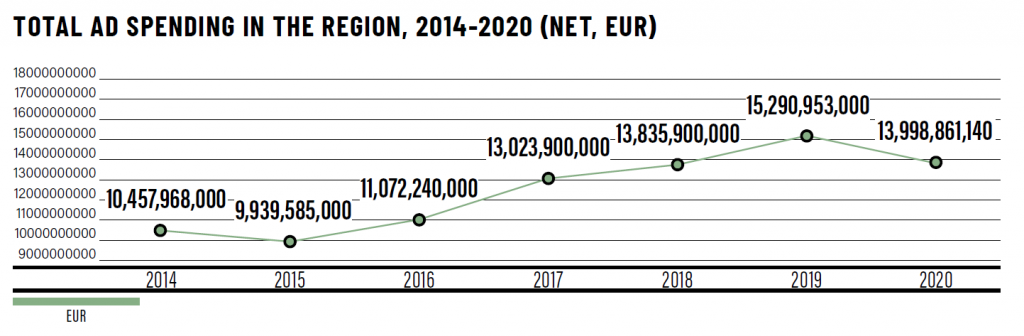
Most weCAN experts report that business recovered relatively quickly after the initial shock and budget freeze. Campaigns were largely postponed rather than cancelled, or restructured to direct more spending towards digital. Businesses adapted to changing consumer habits by moving online or strengthening their existing presence. Digital advertising expenditure rose by €100 million, or 1% year on year, making it the only media segment to grow during the crisis.
More than half of CEE countries experienced only a small decline, or even modest growth, in advertising expenditure. Markets with strong digital sectors were the most resilient, including most Visegrád countries, Russia and Ukraine. In Russia, expenditure fell by 16% when measured in euros, reflecting the rouble’s decline to its lowest level in almost five years. In roubles, the fall was just 4%.
The pandemic accelerated established trends. Television remained the most popular medium on average across the 15 countries studied, but online advertising accounted for more than half of total expenditure in 2020: 51%, or €7.12 billion, compared with television’s 36%, or €4.97 billion. Print continued to decline, while outdoor and radio also lost share.
Government spending on COVID-19 communication
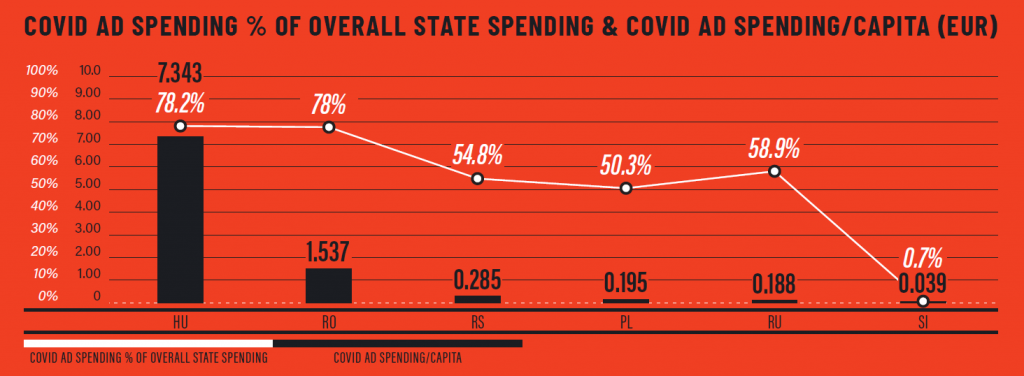
The report compares government communication spending in six countries in 2020. Budgets for public information and education varied considerably, as did the share devoted to COVID-19. Campaigns covered safety measures such as curfews and mask requirements, financial support and public wellbeing.
The Hungarian Prime Minister’s Office spent €79 million net on advertising, with more than 75% devoted to COVID-19 communication. Romania allocated 78% of its public communication budget to this purpose, while Serbia, Poland and Russia spent around half. Slovenia allocated the smallest share: a single television campaign represented less than 1% of its €10 million public advertising budget.
Looking ahead to recovery
Although COVID-19 caused a sharp fall in advertising expenditure, most weCAN experts expected CEE markets to recover faster than after the 2008 financial crisis. They anticipated a return to, or growth beyond, pre-crisis spending levels in 2021, with year-on-year growth of 10–15% expected in many countries.
The full report can be downloaded:
For more information please contact: